For building product manufacturers, the value of product data is no longer just in having it. It is in making it easy for customers to use when they are trying to maximise Green Star points, respond to government tenders, meet Infrastructure Sustainability requirements or compare lower-carbon product options.
That is where Product Carbon Footprints and Digital Product Passports can work together.
A verified Product Carbon Footprint gives customers credible carbon data for a product. It can help support upfront carbon calculations, low-carbon procurement, specification decisions and sustainability rating tool submissions.
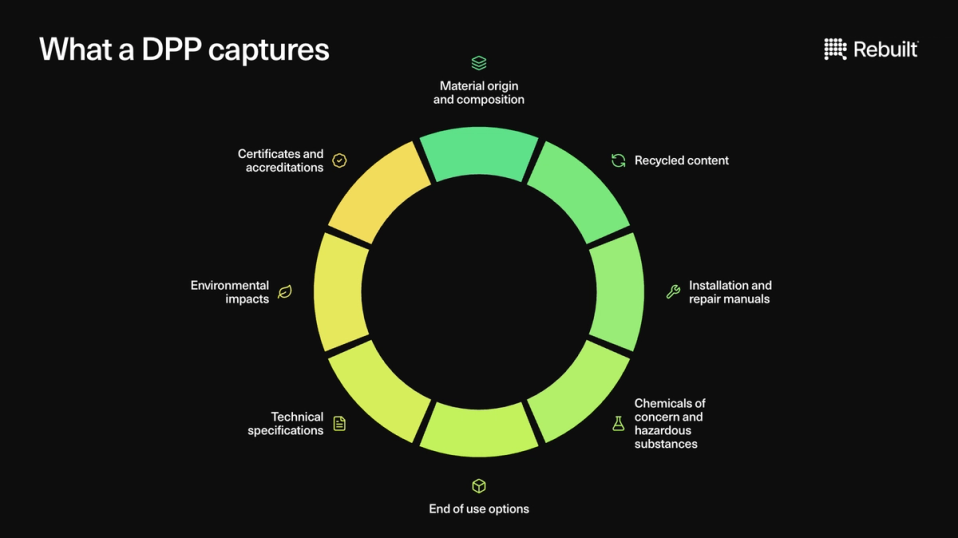
A Digital Product Passport helps bring that carbon evidence together with the other information project teams need, including material composition, certifications, recycled content, warranties, compliance documentation, disassembly potential and end-of-life guidance.
For Green Star projects, this matters because the evidence is not only about carbon. Project teams may also need traceable information about material composition, circularity, product recovery and whole-of-life impacts.
A DPP can help put that information in one structured, accessible record.
What a PCF provides
A PCF answers a critical question: What is the carbon impact of this product?
It provides verified carbon data that can support product comparison, embodied carbon calculations, Scope 3 reporting and evidence for low-carbon procurement.
What a DPP adds
A DPP answers the next question: What else does a project team need to know to specify, procure, use and recover this product well?
It can bring together:
- Verified carbon data
- Material composition and substances
- Certifications and compliance documentation
- Recycled content and environmental impact information
- Origin and manufacturing information
- Warranties and maintenance details
- Disassembly, recovery and end-of-life guidance
This helps avoid product information being spread across certificates, technical data sheets, spreadsheets and supplier emails.
Why the combination matters
Together, PCFs and DPPs help manufacturers give customers more complete and usable evidence.
For buyers, specifiers and project teams, that can mean clearer information to support:
- Green Star and Infrastructure Sustainability submissions
- Government tenders and procurement requirements
- Product comparison and low-carbon specification
- Circularity and design-for-disassembly decisions
- Project documentation and reporting
The PCF does not replace the DPP, and the DPP does not replace the PCF.
The PCF provides credible carbon proof. The DPP makes that proof easier to find, share and use alongside the broader product evidence customers are increasingly asking for.
A more practical pathway
Rebuilt and Rosella Street have partnered to help manufacturers take this next step.
Rebuilt customers can add their verified PCF to a Rosella Street Digital Product Passport, alongside the certifications, material information and circularity evidence they already hold.
Rosella Street customers can also access Rebuilt’s verified PCF service to strengthen the carbon evidence within their passport.
For manufacturers, the opportunity is simple:
Do the work once. Make it easier for customers to use wherever it matters.
Carbon proof and product transparency are stronger together.