By Dr Caroline Noller
Australia’s commercial office sector is facing a silent but material carbon and waste problem: furniture churn.
- The average A-grade office fitout carries approximately 760 kg CO₂-e per sqm, with furniture and joinery responsible for 35% of that footprint.
- With average lease terms now just 31 months, most office spaces are refitted roughly 10 times over a building’s 27-year life.
- This results in a cumulative furniture carbon impact of ~2.5 tonnes CO₂-e per sqm, comparable to the embodied carbon of the base building itself.

Millions of tonnes of commercial furniture are discarded annually, representing a significant and avoidable emissions source.
Despite decades of discussion, meaningful progress has stalled, largely due to behavioural and structural barriers rather than technical ones.
The data is clear: without a structural shift toward circular procurement, product transparency, and longer-life design, furniture churn will continue to undermine net-zero ambitions across the property sector.
The opportunity is equally clear: manufacturers and asset owners who embrace carbon disclosure and circular models can materially reduce embodied carbon, differentiate in the market, and future-proof portfolios against tightening ESG expectations.
The industry has talked. The numbers now demand action.
For decades, the property sector has acknowledged the problem of commercial furniture waste. Millions of dollars have been invested in guides, working groups, sustainability initiatives, and advisory papers. Yet measurable system-wide change remains limited.
As a carbon practitioner of thirty years, I have seen “recycled, reclaimed, reused” appear in countless design briefs. The aspiration is nearly universal. The implementation is not.
Encouragingly, carbon declarations for furniture products are increasing. But aspiration without accountability does not shift markets. Measurement does.
As the saying goes: what gets measured gets managed.
If we want to transform the “desire for new” into “demand for circular,” we must expose the true scale of carbon and waste embedded in current practices.
The carbon reality of office fitouts
According to RICS and industry carbon benchmarking data, the average embodied carbon footprint of an Australian A-grade commercial office fitout is approximately:
- 760 kg CO₂-e per sqm (NLA)
- Of that total, loose furniture and fixed joinery account for approximately 35% or:
- ~266 kg CO₂-e per sqm attributable to furniture alone.
That is before considering churn.
Lease compression = carbon multiplication
Post-COVID leasing patterns have materially shortened. The average Australian office lease term has reduced to approximately 31 months. By comparison, the average commercial office building lifespan is approximately 27 years
This means a typical office space may undergo a major fitout renewal roughly 10 times during a building’s life.
When furniture is replaced with each churn cycle, the cumulative impact becomes significant:
266 kg CO₂-e per sqm × 10 cycles = ~2.5 tonnes CO₂-e per sqm
Over the building’s lifespan, furniture-related carbon can approach the embodied carbon of the structure itself. This is not marginal. It is structural.
Waste at the national scale
High churn translates directly into landfill pressure.Industry estimates suggest that millions of tonnes of office furniture are discarded annually in Australia. This waste stream carries a carbon footprint estimated in the order of 1.75 million tonnes CO₂-e, comparable to thousands of residential homes built from scratch.
Furniture waste is not a minor operational issue; it is a systemic embodied carbon risk.
Product-level evidence: transparency drives performance
When we examine individual products, the carbon intensity gap becomes even clearer.
Office Chairs
- Average wheeled office chair: ~300 kg CO₂-e
- Carbon-labelled alternatives: 80–220 kg CO₂-e
Manufacturers who measure and disclose consistently outperform those who do not. Carbon accounting drives material selection changes, recycled content increases, and process optimisation. Transparency correlates with reduction.
Sit-Stand Workstations (1600mm)
- Broader market average: ~700 kg CO₂-e
- Carbon-labelled products: 300–547 kg CO₂-e
The range is substantial, and avoidable. The data shows two clear things:
- The carbon reduction potential already exists.
- It is not yet standard practice.
The real barrier: not technical, behavioural
Research by Fini and Forsythe (2020) identified three primary barriers to recycling and reuse in office fitouts:
- Goods lift constraints
- Time pressures between demolition and adaptation
- Desire
The third barrier, desire, was identified as the most influential.In other words, the industry’s biggest obstacle is not engineering capability. It is a cultural preference for “new”. Circular reform therefore requires:
- Procurement frameworks that value carbon over aesthetics alone
- Lease structures that incentivise reuse
- Carbon disclosure as baseline expectation
- Residual value recognition for furniture assets
Without economic alignment, circularity remains optional.
The strategic opportunity
If the furniture sector universally adopted ISO-aligned carbon declarations and actively pursued lower-carbon materials and circular design, the 35% fitout carbon component could shrink rapidly. For asset owners and developers, this presents a strategic lever:
- Lower embodied carbon intensity per lease cycle
- Reduced Scope 3 exposure
- Improved ESG performance
- Alignment with tenant sustainability expectations
- Competitive differentiation in a tightening regulatory environment
Circularity is not a marginal sustainability initiative. It is a portfolio-level risk mitigation strategy.
The path forward
The sector does not lack knowledge. It lacks systemic application.
To reform commercial furniture impacts at scale, we must:
- Mandate carbon disclosure in procurement
- Prioritise lower-carbon labelled products
- Design for disassembly and reuse
- Extend fitout life beyond lease cycles
- Create economic signals that reward retention, not replacement
The shift from linear consumption to circular systems is not philosophical; it is mathematical.
The carbon arithmetic of churn is now undeniable. The only remaining question is whether the industry will act before regulation forces it to.
Sources:
Australian Furniture Association: https://australianfurniture.org.au/sustainable-government-procurement-of-furniture/
Re-Leased State of Office Report, 2024: https://www.re-leased.com/blog/australian-state-of-office-and-retail-leasing-report-2024
Dr Caroline Noller MRICS, Prsented at RICS CPD Seminar and Networking - The Journey to Net Zero, Gosvenor Place, 21/03/2024
Fini.A, & Forsthe.P " Barrier to reusing and recycling office fitout, Dec 2020
Waste Account, Australia, Experimental Estimates: https://www.abs.gov.au/statistics/environment/environmental-accounts/waste-account-australia-experimental-estimates/latest-release
Discover more
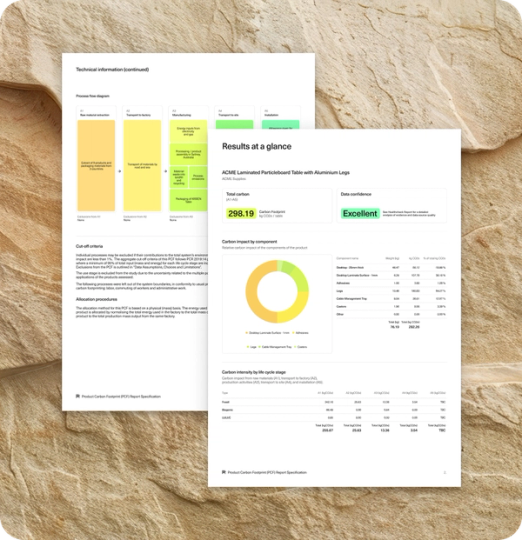
Corporates won’t hit their carbon targets without fixing this data problem
Insights
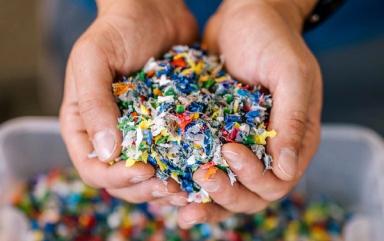
Recycled, recyclable, or just wishful thinking?
Insights
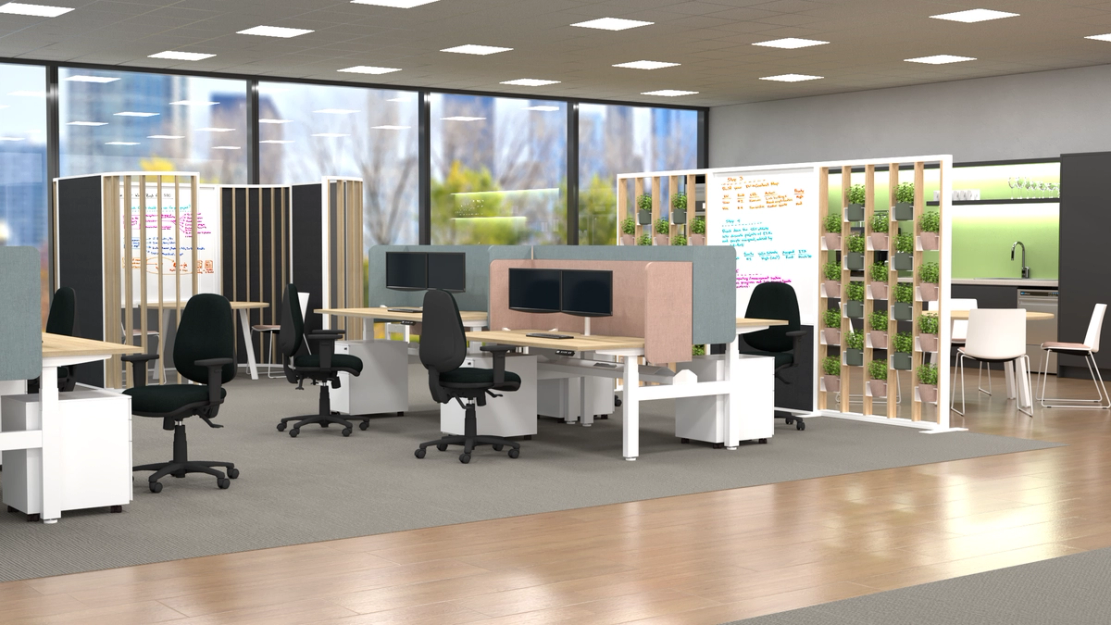
From product carbon to product innovation, what Rebuilt’s work with furniture manufacturers is showing
Insights
EPD or PCF? How to keep building product-specific data working hard in a capital-constrained economy
Insights
Product Carbon Footprint Labels: Quantifying the Value of Circular Materials in Reshaping Construction
Insights
Make carbon a feature, not a footnote: Turn every chair, workstation, and panel into verified data
Insights