By Simon O’Brien
There is a quiet contradiction sitting inside many corporate net-zero strategies. On one hand, organisations are setting increasingly ambitious carbon targets. Scope 3 commitments. Science-based trajectories. Board-endorsed decarbonisation pathways.
On the other hand, much of the data underpinning those commitments, particularly for purchased goods, materials, and construction, is still built on averages, proxies, and assumptions that were never designed for this level of scrutiny.
The uncomfortable truth is this:
You cannot manage what you cannot meaningfully see. And you cannot reduce what your data smooths away.
For many corporates, the largest emissions reductions will not come from energy efficiency, renewable procurement, or internal operations. They will come from the supply chains, products, materials, and components the organisation buys. Yet supply chain emissions data remains, in many cases, structurally weak. Not because organisations lack intent. Because the data infrastructure hasn’t caught up with the targets.
Why is this problem becoming impossible to ignore
As climate disclosures mature and standards tighten, emissions data is no longer just a sustainability concern. It is a governance issue. Boards are being asked to stand behind Scope 3 numbers. Investors are questioning the reduction pathways. Assurance expectations are rising. And organisations are discovering that much of their upstream emissions data is not really data at all, it is estimation logic.
Spend-based factors. Industry averages. Generic databases. Useful starting points, but increasingly fragile foundations for long-term strategy. This is where Product Carbon Footprints (PCFs) are rapidly moving from “emerging practice” to strategic necessity. Not because they are fashionable. Because they address a structural blind spot.
Corporations trying to reduce emissions face three hard realities
Across sectors and geographies, leading organisations are converging on the same lessons.
- Averages hide the decisions that actually matter
Generic emissions factors compress variation. They assume similarity across suppliers, production methods, and technologies. That makes reporting easier. It makes reduction harder. Two products that look identical in a database may differ dramatically in real emissions intensity depending on energy sources, feedstocks, manufacturing processes, or logistics. - Without product-level data, those differences disappear.
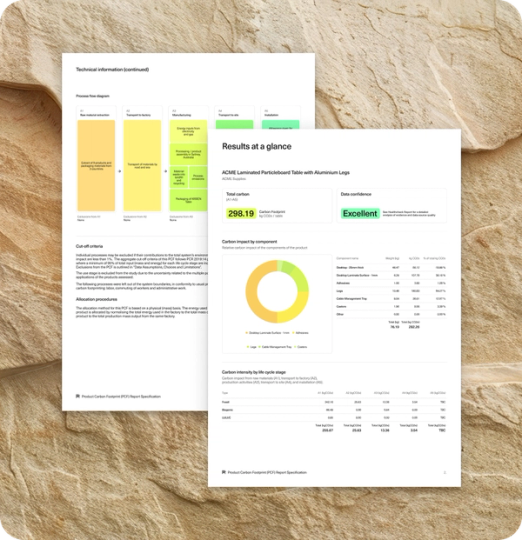
A PCF restores that visibility. It ties emissions to an actual product from an actual supplier, rather than a statistical proxy. That difference becomes critical when organisations move from measuring to managing. - Supplier engagement only works when the numbers feel real
Many companies struggle to drive meaningful decarbonisation conversations with suppliers because the data feels abstract. It is difficult to have a serious commercial discussion about emissions reductions when the baseline itself is an industry average. PCFs change the nature of that conversation. They connect emissions to specific products, creating clarity around where reductions are technically possible, commercially relevant, and measurable over time.
This is one reason large multinationals such as BASF have invested heavily in collecting supplier PCFs across thousands of inputs. Not for reporting aesthetics, for procurement leverage and credible reduction planning Once emissions are attached to what is actually being purchased, carbon becomes a manageable variable rather than a modelling artefact. - Disclosure pressure exposes the limits of project-style data
Environmental Product Declarations (EPDs) have played an important role in improving transparency in the built environment and manufacturing sectors. But EPDs were not designed as dynamic corporate emissions infrastructure. They are typically:
- Static
- Periodic
- Difficult to aggregate across portfolios
- Optimised for disclosure rather than decision-making
Most importantly, they often describe product categories, not necessarily the specific configuration a company procures. PCFs operate differently. They are:
- Product-specific
- Methodologically consistent
- Easier to integrate into Scope 3 accounting systems
- Designed for repeatable exchange and comparison
This is why initiatives such as WBCSD’s Partnership for Carbon Transparency (PACT) are focusing on PCFs as the backbone of future supply chain emissions data exchange. EPDs tell you a story about a product. PCFs allow you to run a system.
What organisations will increasingly need
If corporates are serious about hitting long-term carbon targets, rather than simply disclosing progress, three capabilities are becoming non-negotiable.
- Visibility that reflects reality
Not averages. Not spend proxies. Product-level emissions tied to what is actually bought. - Data that survives reuse and scrutiny
Numbers that can be compared year-on-year, explained internally, and defended externally. - Supplier signals that drive behaviour
Data structures that enable procurement decisions, not just reporting outputs.
PCFs are uniquely positioned to support all three.
Why this shift is accelerating globally
Across Europe, North America, and parts of Asia, product-level carbon accounting is moving rapidly into mainstream corporate practice. Regulatory pressure is one driver. Procurement and competitive differentiation are others.
Automotive supply chains, for example, are already building shared PCF exchange ecosystems through networks such as Catena-X, recognising that Scope 3 reduction strategies cannot function on generic assumptions indefinitely. Once product-level emissions data becomes interoperable, expectations compound quickly.
The strategic implication
Carbon targets are easy to write. Carbon reductions are data constrained. The next phase of corporate decarbonisation will not be defined by new commitments. It will be defined by the quality of the information flowing through supply chains.
Organisations that continue to rely primarily on generic emissions proxies will find reduction pathways increasingly difficult to defend. Organisations that invest in product-level emissions infrastructure will find decision-making, supplier engagement, and disclosure confidence materially easier.
Where Rebuilt fits
At Rebuilt, we work with organisations navigating exactly this shift, helping translate embodied carbon and supplier emissions data into structures that function at enterprise scale. Not to chase theoretical precision. To reduce uncertainty, improve defensibility, and make supply chain emissions genuinely manageable. If this challenge is starting to feel familiar, we’re always happy to have a practical conversation.
Discover more
Corporates won’t hit their carbon targets without fixing this data problem
Insights

Recycled, recyclable, or just wishful thinking?
Insights

From product carbon to product innovation, what Rebuilt’s work with furniture manufacturers is showing
Insights

EPD or PCF? How to keep building product-specific data working hard in a capital-constrained economy
Insights

Product Carbon Footprint Labels: Quantifying the Value of Circular Materials in Reshaping Construction
Insights

Make carbon a feature, not a footnote: Turn every chair, workstation, and panel into verified data
Insights