Sustainability action has always ebbed and flowed with the economic cycle. Bold research and ambitious leadership projects thrive in buoyant markets. Under tighter conditions, prudent, short-ROI compliance investments take precedence. But collectively, the industry has always weathered the storms.
It's fair to say we are not in a period of bold climate action right now. Uncertainty abounds across global markets and supply chains. A 1.5 degree future may now be difficult to avoid, but that's not a reason to stop trying, and it's certainly not a reason to stop acting. We still have a solid regulatory and corporate framework pushing us toward sensible, cost-effective, incremental carbon reduction. The task is to direct available capital where it will do the most good: renewable energy, local manufacturing, and the kind of systematic carbon transparency that makes the whole system work better.
For a growing number of manufacturers, that means starting with a verified Product Carbon Footprint.
The financial case
Because they focus on carbon only, PCFs are significantly faster and less expensive to produce than full EPDs.
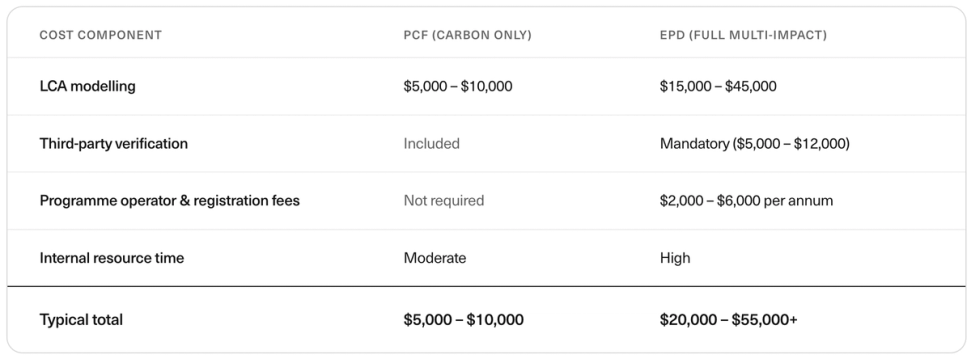
At portfolio scale, that difference becomes significant. For a manufacturer seeking disclosure across 20 product lines, PCF coverage at an average of $7,500 per product costs around $150,000. Full EPD coverage across the same products, at an average of $35,000 each, could cost closer to $700,000. That difference represents capital that can instead go toward product redesign, supplier engagement, renewable energy, or selective EPD investment where it will deliver the greatest return.
For SME and component manufacturers in particular, this can be the difference between acting now and delaying disclosure altogether.
The case for starting with a PCF
As product-level carbon data becomes a standard requirement across construction and manufacturing supply chains, many manufacturers are asking the same question: where do we invest first?
For businesses that need to move quickly, cover more products, and start using carbon data as a real business tool, PCFs are proving to be the most practical entry point. They focus on what the market is asking for most urgently, credible, verified, product-level carbon data, and they can do it faster, at lower cost, and across a broader portfolio than a full Environmental Product Declaration.
Critically, a PCF is not a compromise. It is a no-regrets investment. The data you collect, the supplier engagement you complete, and the LCA boundaries you establish all carry forward. A PCF can ladder up to a full EPD later, meaning you are building toward deeper disclosure from day one, not starting over.
What a PCF actually enables
This is where the real value lies, not just in having a number, but in what that number lets you do.
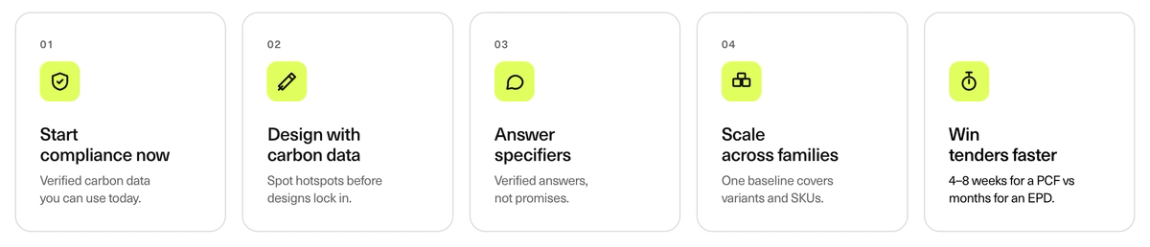
Start your compliance journey immediately.
Rather than waiting months for full EPD coverage, a PCF gives you verified, standards-aligned carbon data you can put to work now. It satisfies Scope 3 data requests, responds to embodied carbon targets, and meets an expanding range of procurement and tender requirements, without the cost and complexity of a full EPD across every product line at once.
Make better design decisions earlier.
With carbon data in hand at the product and material level, your design and engineering teams can identify hotspots, compare material options, and model lower-carbon alternatives before a design is locked in. This is where carbon data shifts from a reporting obligation to a genuine design tool.
Have pre-sales conversations with confidence.
When a specifier, developer, or major customer asks about your product carbon footprint, a verified PCF means you have an answer, not a promise to get back to them. That's increasingly the difference between being on the shortlist and not.
Fill out a product family efficiently.
A PCF established for a lead product creates a foundation for the rest of the family. Variants, grades, and mix designs can be assessed relative to that baseline, giving you portfolio-wide carbon visibility without starting from scratch for every SKU.
Respond to tenders, fast.
Carbon data is appearing in procurement requirements across government, commercial construction, and major supply chains. A PCF can often be completed in four to eight weeks. A full EPD may take several months. Where carbon data influences tender outcomes, earlier disclosure is a commercial advantage, not just a compliance checkbox.
Where EPDs fit, and why they still matter
None of this diminishes the role of Environmental Product Declarations. EPDs remain essential where multi-impact transparency is required, where certification alignment or existing contracts specify them, or where you are operating in market segments that demand the full picture.
For manufacturers dealing with complex upstream supply chains, virgin material extraction, or agricultural inputs, EPDs provide a scientific rigour and breadth that carbon-only assessment doesn't cover. And for flagship products in high-value commercial market segments, the investment in a full EPD continues to deliver strong returns.
The point is not to choose one over the other. It's to understand how they work together, and to sequence your investment wisely.
A PCF can serve as the first verified output in a product family, with an EPD following for priority products. An existing EPD from a material supplier can feed directly into your PCF as a high-quality upstream data input, improving accuracy without additional cost. And where a full EPD is the eventual goal, the data collection, supplier engagement, and LCA boundary-setting you complete for your PCF means the path to that EPD is significantly shorter.
A smarter way to sequence disclosure
In practice, the most effective manufacturers are taking a phased approach, and it looks something like this.
A steel manufacturer deploys PCFs across a portfolio of multiple grades using a common process, responding to Scope 3 data requests at scale without needing a full EPD for every product. A concrete supplier uses upstream EPDs as inputs to model bespoke low-carbon mix designs, generating PCFs to support those mixes before a full EPD cycle is complete. An insulation or component manufacturer uses PCFs to achieve portfolio-wide carbon disclosure, while reserving EPD investment for the products where it will unlock the most value commercially.
In each case, the PCF isn't replacing the EPD. It's enabling a faster, more efficient path to transparency, and keeping capital available for the investments that matter most.
What this means for manufacturers now
Carbon transparency is becoming core business infrastructure. Manufacturers are being asked for better data, across more products, with greater speed and confidence.
PCFs are one of the most practical tools available for meeting that demand. They help organisations move quickly, build internal capability, support design and pre-sales conversations, and respond to market requirements, without the cost and complexity of full EPD coverage from day one.
EPDs remain critical where broader environmental disclosure is needed, and the two work best when used together strategically. But for most manufacturers, PCFs are what make large-scale, product-level carbon transparency possible in the first place.
The most effective strategies aren't built around choosing one or the other. They're built around starting smart, using PCFs to move quickly, generate value early, and create a foundation that supports everything that follows.
Discover more
Corporates won’t hit their carbon targets without fixing this data problem
Insights

Recycled, recyclable, or just wishful thinking?
Insights

From product carbon to product innovation, what Rebuilt’s work with furniture manufacturers is showing
Insights
EPD or PCF? How to keep building product-specific data working hard in a capital-constrained economy
Insights

Product Carbon Footprint Labels: Quantifying the Value of Circular Materials in Reshaping Construction
Insights

Make carbon a feature, not a footnote: Turn every chair, workstation, and panel into verified data
Insights