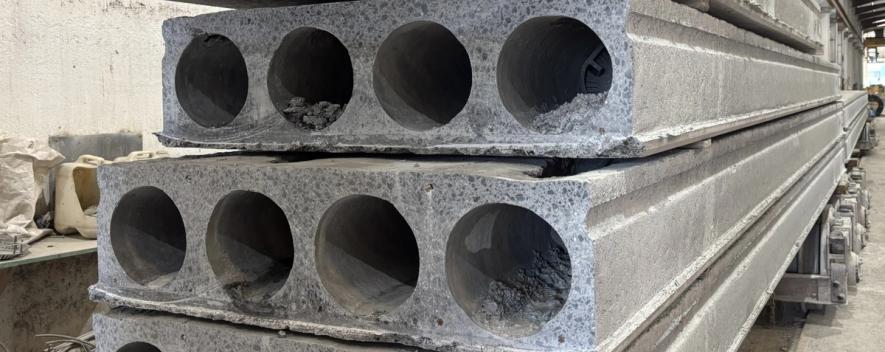
Concrete innovation is accelerating faster than most precast manufacturers realise. The science is moving, the standards are catching up, and the market signals are getting louder. If you're waiting for the dust to settle before acting, you may find your competitors have already moved.
We've been tracking the work coming out of SmartCrete CRC, Australia's federally funded cooperative research centre for sustainable concrete, and speaking with the people at the centre of tracking and driving innovative practice, the incredible Clare Tubolets, CEO SmartCrete and Dr Vute Sirivivatnanon, Research Director SmartCrete, to get their hot takes about what precast producers need to understand right now.
⚡ HOT TAKE #1. The barrier isn’t conservatism, it’s momentum.
Engineers and specifiers have always been, and should remain, appropriately cautious. When you’re responsible for assets with decades-long design lives, decisions must be grounded in evidence, performance, and reliability.
That evidence now exists.
Across Australia and globally, lower-carbon concrete solutions have been tested, validated, and deployed. The technical case is no longer the constraint. What’s emerging instead is a gap between what is proven, and what is routinely specified.
This isn’t about resistance, it’s about inertia.
“Established practices, limited visibility of alternatives, uncertainty around responsibility, and fragmented information flows all make it harder to shift from what we know works to what we know also works, and delivers lower emissions.” said Clare Tubolets.
At the same time, the market is moving.
Governments are embedding carbon measurement into procurement. Developers are setting embodied carbon targets earlier in the design process. Clients who once accepted a standard mix are now asking for data, transparency, and options.
The opportunity, and the risk, sits in that gap.
The organisations that can translate proven innovation into standard practice will move with the market. Those that can’t, may find themselves reacting to it.
The challenge isn’t proving that low-carbon materials work.
It’s making them easy to choose.
There are two types of low-carbon concrete. You need to understand both.
Dr Vute Sirivivatnanon, Research Director at SmartCrete CRC and Professor of Concrete Engineering at UTS, identifies two main categories. The first is concrete with supplementary cementitious materials (SCMs), slag, fly ash, natural pozzolans, which still contains Portland cement but at a significantly reduced proportion. This is the low-carbon concrete being deployed at scale right now. The second is geopolymer concrete, which contains zero or very low Portland cement and achieves substantially lower embodied carbon as a result.
For precast manufacturers, this distinction matters in practice. SCM-blended concretes are largely available today and can be adopted with modest process adjustments. Geopolymer concrete offers deeper carbon reductions but comes with a different set of performance, durability, and specification challenges that are being actively resolved through current research.
The practical implication: start with SCM blends to reduce your carbon footprint now, while watching the geopolymer space closely. The standards and technical guidance are developing quickly.
⚡ HOT TAKE #2. SCMs don't kill your one-day strength, poor mix design does.
The most common objection to fly ash and slag in precast is that they slow early strength development and disrupt daily production cycles. The evidence tells a more nuanced story. SCMs do slow strength gain at standard temperatures, but with appropriate mix design, optimised water-to-binder ratios, polycarboxylate-based superplasticisers, adjusted curing regimes, and ternary blends, precast manufacturers can achieve the early-age strengths needed for daily demoulding and detensioning. The same SCMs that reduce your embodied carbon also improve long-term strength, reduce permeability, and suppress both alkali-silica reaction and delayed ettringite formation. The trade-off is a mix design investment, not a production ceiling.
Your production process is a carbon lever you're probably underusing
Precast has a structural advantage that ready-mix doesn't: a controlled factory environment. That means more precise mix design, better quality control, and, critically, the ability to test and validate new formulations systematically before they go near a job site.
Vute and his team at the UTS-Boral Centre for Sustainable Building have been pushing the boundaries of SCM replacement rates in precast applications specifically,working to lift the maximum replacement rate of ordinary Portland cement while maintaining the fresh and early hardened properties of concrete required for optimum construction efficiency, and optimising all durability properties critical to achieving design life.
What this means for precast producers is that the ceiling on cement replacement is higher than many currently assume, and that your factory environment puts you in a better position than most to test and validate it. The question isn't whether low-carbon mixes are achievable in precast. It's whether you're actively developing the in-house knowledge to specify and produce them confidently.
The early strength concern is real but manageable. Fly ash reaches its maximum strength more slowly than concrete made with only Portland cement, and slag behaves similarly at standard temperatures. But with well-designed ternary blend systems, optimised superplasticiser selection, and appropriately managed heat curing protocols, precast producers can achieve the early-age strengths needed for daily production cycles. The pay-off is significant: better long-term strength, reduced permeability, improved surface finish, and lower embodied carbon, all from the same mix change.
⚡ HOT TAKE #3. The DEF temperature limits that have constrained your curing regime were built for a different cement. Australian research says the risk is low — and the specifications need to catch up.
Precast manufacturers have been operating under curing temperature limits derived largely from international standards written for cements with higher sulphate and alkali contents than Australian products. Eight years of UTS research, led by Dr Paul Thomas, A/Prof Kirk Vessalas and Prof Vute Sirivivatnanon, supported by Humes (Holcim) Australia shows that with conforming Australian cements and fly ash in the mix, the risk of deleterious DEF is low even at 90°C. The same SCMs reducing your carbon footprint are also your best DEF mitigation. The specifications have been updated to reflect this, removing a compliance burden that has been unnecessarily constraining productive curing practices.
The DEF problem was real, but research shows it was also overstated, and the rules are changing
Here's a technical issue that has quietly shaped precast operations for years, and where recent Australian research is shifting the ground.
Heat and steam curing is standard practice in precast concrete production; it accelerates strength development and improves throughput. But elevated curing temperatures create a potential durability risk known as Delayed Ettringite Formation, or DEF.
During normal cement hydration, ettringite, a calcium sulphoaluminate mineral, forms in the plastic state of the concrete, where it is harmless and in fact beneficial to the setting process. When concrete temperature during curing exceeds approximately 65–70°C, however, ettringite becomes unstable. Its formation is halted, and the constituent sulphate and aluminate compounds are absorbed into the calcium silicate hydrate matrix. After cooling, those compounds are available to form ettringite again, this time within hardened concrete. Because the concrete can no longer accommodate the volumetric expansion, the delayed crystallisation exerts internal stress on the matrix, potentially causing expansion and cracking.
To manage this risk, Australian state road and transport authorities including Transport for NSW (TfNSW B80), Queensland's Transport and Main Roads (MRTS 70), and South Australia's Main Roads Specification (MRS 820) have imposed temperature limits of 70 to 80°C on heat and steam cured concretes, depending on jurisdiction. Breaching those limits, even inadvertently during a mass pour where the heat of hydration itself drives temperature rise, has put precast manufacturers in a difficult compliance position.
The problem is that those limits were largely derived from international research conducted with cements whose sulphate and alkali contents are not as tightly regulated as Australian standards require. Research carried out over eight years by Paul Thomas, Kirk Vessalas and Vute Sirivivatnanon, in partnership with Humes (Holcim) Australia indicates that the risk of deleterious DEF is low for concretes manufactured using Australian cements conforming to AS 3972 and ATIC-SP43, which restrict sulphate content to 3.5% SO3 and alkali content to 0.6% Na2Oe, even when concrete temperatures rise to 90°C during curing. The risk is further mitigated when fly ash is included in the mix design.
In short: the temperature limits have been overly conservative for Australian conditions, and the specifications have not adequately recognised the protective role that SCMs, already widely used for carbon reduction, play in suppressing DEF risk.
The research concludes that low specified temperature limits are therefore unnecessary, wasteful and reduce productivity, and calls for specifications to be readdressed, with requirements based on binder composition rather than curing temperature alone.
This matters for precast manufacturers on two fronts. First, it reduces the compliance burden around curing temperatures, removing a source of uncertainty that has created operational friction and, in some cases, unnecessary caution around higher-throughput curing regimes. Second, and more significantly, it reinforces the case for SCM-blended mixes: the same fly ash and slag additions that reduce your product's embodied carbon also demonstrably reduce the risk of DEF. The low-carbon mix and the durable mix are, in this case, the same mix.
Manufacturers should verify current requirements with their relevant authority before adjusting curing protocols. But the direction of travel is clear, and the research base underpinning it is robust.
The SCM supply question is real, and worth planning for
Fly ash and slag, the most widely used SCMs, are by-products of coal-fired power stations and steel manufacturing respectively. As those industries decarbonise, supply will tighten. SmartCrete CRC is actively investing in research into alternative cementitious materials: natural pozzolans, calcined clays, industrial waste streams, and novel carbonation-based materials.
One standout example is SmartCrete CRC's partnership with MCi Carbon, whose mineral carbonation technology captures CO2 and turns it into carbon powders and low-carbon silica products for use as a supplementary cementitious material in concrete, creating a triple win by capturing industrial emissions, storing carbon in building materials, and reducing the need for cement.
The hot take here is to get ahead of supply risk now. Diversify your SCM inputs, build supplier relationships across multiple material streams, and keep a close eye on which alternative SCMs are clearing technical and regulatory hurdles. The ones gaining standards recognition now will be in commercial use within a few years.
⚡ HOT TAKE #4. Carbon data is a production input, not just a reporting output, and the manufacturers treating it that way are already winning tenders.
A specifier choosing between two precast suppliers, one with verified carbon data, one without, will choose the one with data, all else being equal. And increasingly, all else won't be equal, because the verified supplier can also offer lower-carbon mix options backed by evidence. Verified Product Carbon Footprints (PCFs) for your product range, including key mix variants, give you the data to have pre-sales conversations, win procurement panels, satisfy Scope 3 requests, and feed directly into NABERS Embodied Carbon and Green Star assessments. For precast, a PCF covering a product family addresses the full range of variants without a separate assessment for every grade. The time to build this capability is before your customers start asking. Most of them already are.
Carbon data is becoming a production input, not just a reporting output
This is the shift that most precast manufacturers haven't fully made yet. Carbon data is increasingly informing decisions at the design and specification stage, which means your clients need it earlier, and you need to be able to provide it in a format they can use.
As governments begin mandating that carbon needs to be measured and addressed through procurement phases, the client has to look at that from the initial concept. That's the world precast manufacturers are entering. A specifier choosing between two precast suppliers, one with verified carbon data, one without, will choose the one with data, all else being equal. And increasingly, all else won't be equal because the verified supplier will also be able to offer lower-carbon mix options backed by evidence.
Verified Product Carbon Footprints (PCFs) for your product range, covering your standard mixes and key variants, give you the data you need to have these conversations. They feed directly into NABERS Embodied Carbon assessments, Green Star submissions, and government procurement requirements. And critically for precast, a PCF for a product family covers the full range of variants without requiring a separate assessment for every grade.
⚡ HOT TAKE #5. The regulatory clock is running, and it's not waiting for the industry to feel ready.
SmartCrete CRC has invested over $40 million in research to transition Australia's concrete sector to net zero by 2050. That research is already translating into updated standards, new specifications, and procurement frameworks that will progressively raise the bar. The manufacturers who are ready, with low-carbon mix capability, verified carbon data, and a track record of innovation, will be setting the benchmarks. The ones who waited will be meeting them under pressure.
The regulatory window is now
SmartCrete CRC has invested over $40 million in 39 innovation collaborations across sustainable concrete, engineered solutions and asset management, with the explicit goal of transitioning Australia's concrete sector to net zero by 2050. That research is translating into new standards, updated specifications, and policy frameworks that will progressively raise the bar on what's expected.
As Clare Tubolets has put it: "At SmartCrete we're helping to fast-track Australia's transition to net zero concrete by 2050. Industry is ready to tackle this challenge."
National Precast supports the work underway through SmartCrete CRC and by researchers helping to build the evidence base and practical pathways for industry.
“Concrete innovation is moving quickly, but for precast manufacturers the real challenge is turning that innovation into solutions that are practical, compliant and scalable. That is where the sector can lead, by helping drive outcomes that reduce carbon while still meeting the performance expectations our industry depends on,” said Cadell Taye, CEO of National Precast
The precast manufacturers who are ready when those frameworks land, with low-carbon mix capability, verified carbon data, and a track record of innovation, will be the ones winning the tenders, holding the customer relationships, and setting the benchmarks others are measured against.
The ones who waited will be catching up.
About Rebuilt
Rebuilt helps precast concrete manufacturers generate verified Product Carbon Footprints for their product range quickly and affordably, covering product families, mix variants, and the data your customers are starting to require. Find out more at rebuilt.eco
Discover more
Corporates won’t hit their carbon targets without fixing this data problem
Insights

Recycled, recyclable, or just wishful thinking?
Insights

From product carbon to product innovation, what Rebuilt’s work with furniture manufacturers is showing
Insights
EPD or PCF? How to keep building product-specific data working hard in a capital-constrained economy
Insights
Product Carbon Footprint Labels: Quantifying the Value of Circular Materials in Reshaping Construction
Insights

Make carbon a feature, not a footnote: Turn every chair, workstation, and panel into verified data
Insights